Around springtime, it is common to encounter bright orange, slimy „flux” on the stumps of felled trees, on fallen trees, and often on the trunks of wounded living trees. This phenomenon is known in English as slime flux, stump flux, or Vernal Orange Slime (VOS), and in Hungarian, it is commonly referred to as „carrot-yellow tree slime.” There are many misconceptions or half-truths surrounding it, both locally within the community of mushroom enthusiasts, and in international forums and groups.
So, which species is it then?!
In mushroom identification groups, it’s natural for curious enthusiasts to want to identify our findings to the most specific taxonomic level possible – to learn, to understand, or perhaps to add another species to our fungal list. However, in this case, we must be cautious. For years, I’ve been observing both Hungarian and international groups, and every spring, countless photos appear asking for identification of the phenomenon (let’s refer to it by its unofficial Hungarian nickname) „carrot-yellow tree slime.” Interestingly, in Hungarian-speaking groups, the species commonly identified is Cryptococcus macerans (a basidiomycetous yeast), while in international groups, the identification usually points to Fusicolla merismoides (the asexual form of a Ascomycete) – in almost every case. It can understandably cause confusion to see the same „fungus” identified with two species that are taxonomically so distant from one another.
The resolution to the dilemma lies in the phenomenon itself, and it’s no accident that I’ve used the term „phenomenon” several times, as the „carrot-yellow tree slime” is not a single fungal species, but rather a fascinating microbial event. Among the main players, we can find numerous fungal species that are genetically distant from one another, belonging to different genera, as well as a variety of bacteria.
To understand this phenomenon, I’ve read several recent (or at least not very old) related articles, with the one I liked the most being Dan Molter „On the Ontology of Vernal Orange Slime” című cikke tetszett (Winter-Spring 2022, Mushroom the Journal), in which he attempts to explain in an accessible way what this orange goo on the trees actually is.
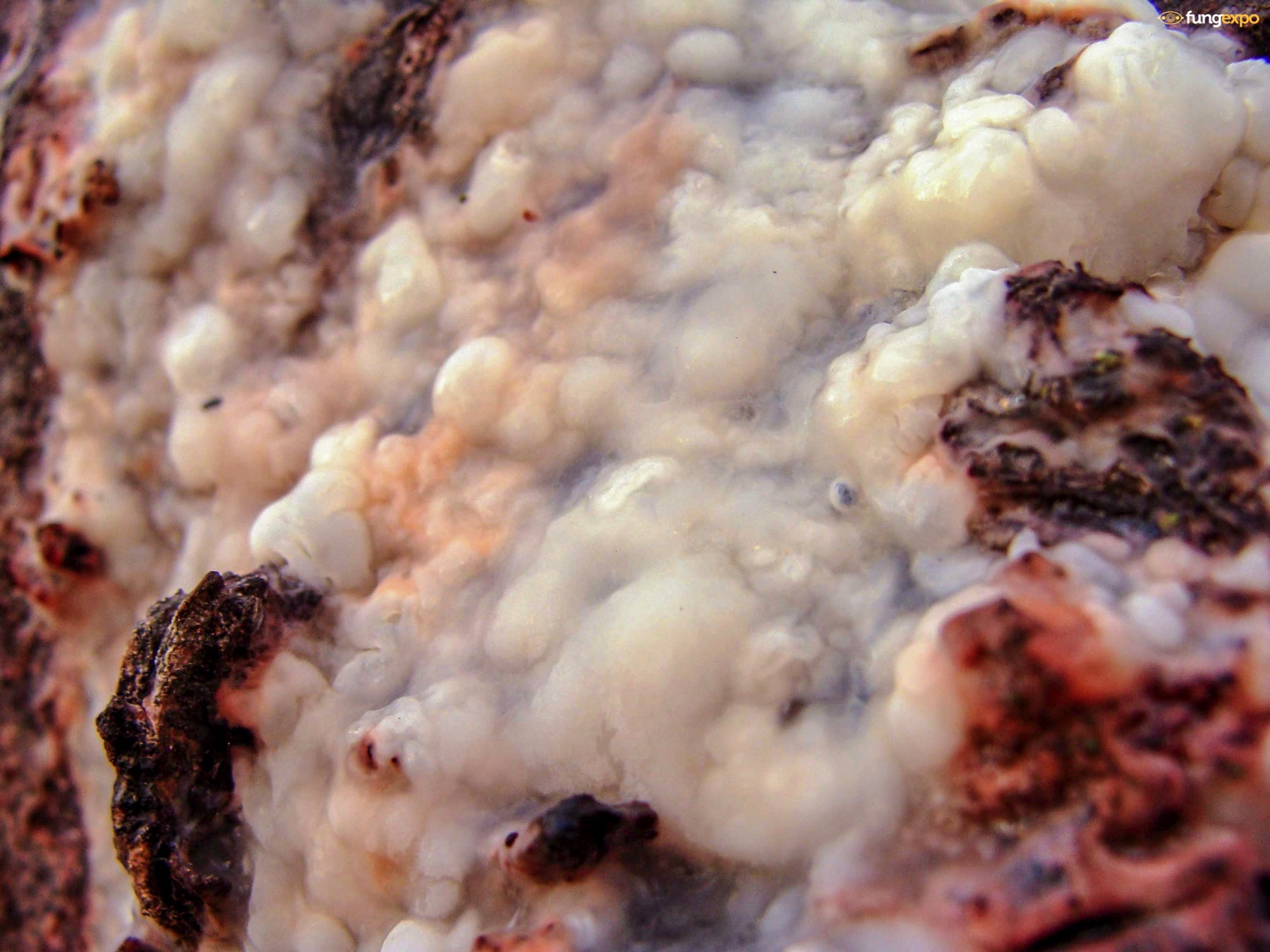
It all starts with an injury
The trees on which the „carrot-yellow tree slime” appears in spring, or freshly felled trees, are still undergoing biological processes or have suffered some kind of injury. In any case, the key point is that sugary sap oozes from the injury to the surface. What follows is something that can most closely be compared to a spring music festival. The invitation and the main stage is the sap leaking from the injury, which is ideal for the colonization of various microbial structures. The „bands” performing at this „festival” are the colonizing microbes, mainly fungal species. And just like at any proper music event, it’s true here as well that the lineup of „bands” differs in both their composition and performance order from year to year and stage to stage (tree to tree). The one thing they all have in common: the party is held every spring, and it ends with roughly the same result.
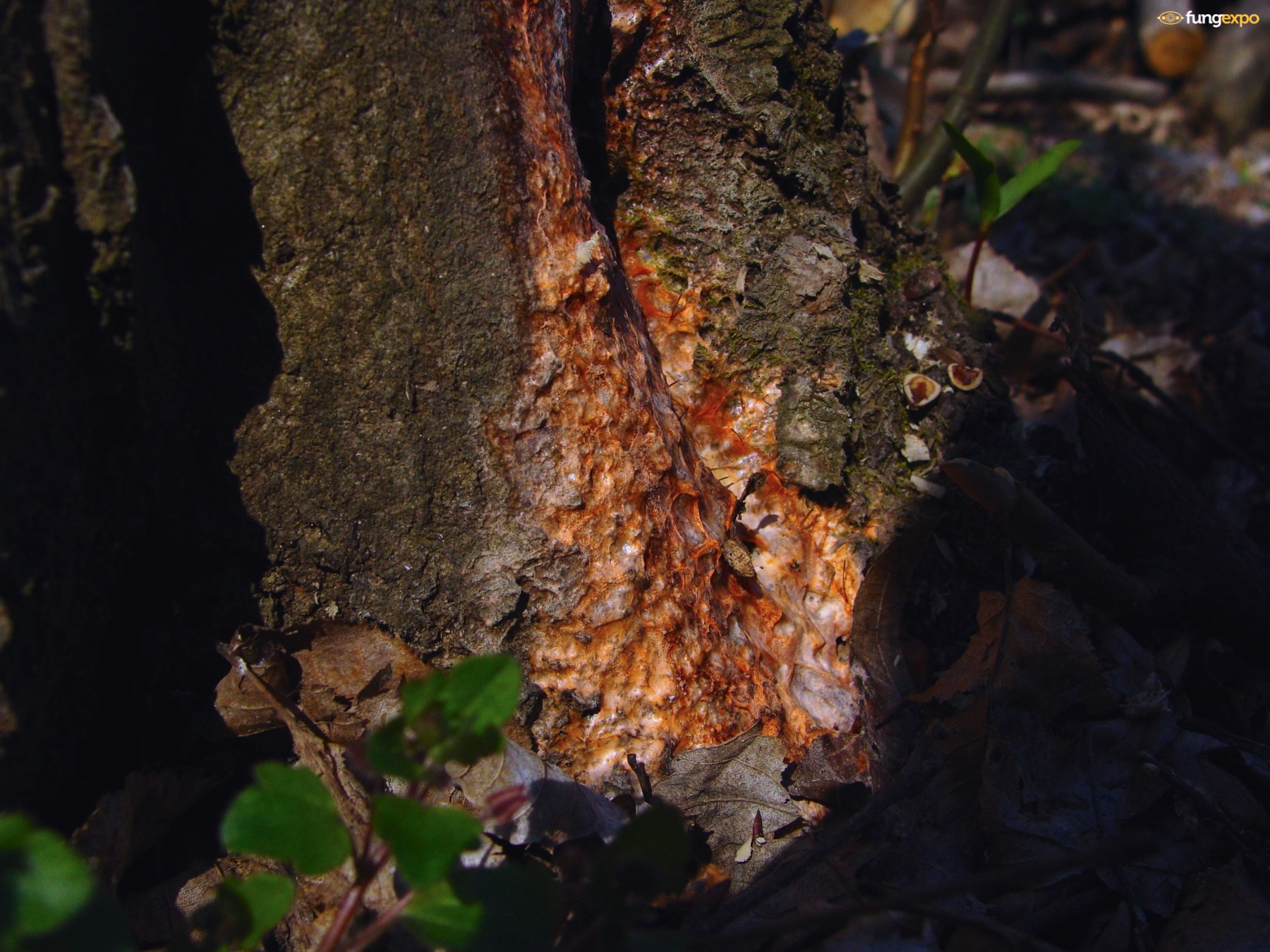
Varied „festival lineup”
This explains how it’s possible that samples taken from tree slime sometimes show one fungal species, and other times show a different one, but the lineup of performers is actually much longer than just the Cryptococcus macerans (which some taxonomies now list as Cystofilobasidium macerans) and Fusicolla merismoides, often mentioned on Hungarian or international forums. These species, which are mistakenly identified with the phenomenon, may indeed be recurring performers at the „festival,” but they are not participants in every case. In many instances, the members of Fusicolla merismoides complex could not be detected at all in the samples. Several sources also suggest that the substance mycocin produced by C. macerans destroys rival yeasts in the sample. This is only partly true, however, as the „festival” never turns into a solo concert, even though the quirks of certain performers may determine who can play and who cannot play right before them, they are not banished from the „event.” Some of the more popular fungal species among the performers, based on the studies presented in Dan Molter’s article:
Cryptococcus skinneri, C. magnus, C. albidus, C. laurentii, C. macerans
They appear in the early stages; they proliferate in sugary sap
Rhodotorula glutinis, Sporidiobolus pararoseus, Nadsonia fulvescens
Protection against oxidation is likely
Candida fermentati, Trichosporon pullulans, Pichia sp.
Early colonizers
Xanthophyllomyces dendrorhous
Astaxanthin-producing, which mostly gives the colony its orange color
Phaffia rhodozyma
Also astaxanthin-producing, which may also contribute to the orange color
Aureobasidium pullulans, Galactomyces geotrichum
It may appear in a later stage
Fusicolla merismoides, Fusarium sporotrichioides, F. acuminatum
Biofilm structure formation, which makes up the texture of the slime
Mucor hiemalis
Structure – with its hyphae, it thickens and strengthens the slime
Cystofilobasidium capitatum, C. infirmominiatum, Hansenia sporauvarum
Their presence is variable, and their role is less well understood
Epicoccum nigrum
Biofilm-forming, with a potential protective role
Mrakia frigida, Metschnikowia sp., Rhizopus sp.
Mixed roles, likely adaptable to environmental influences
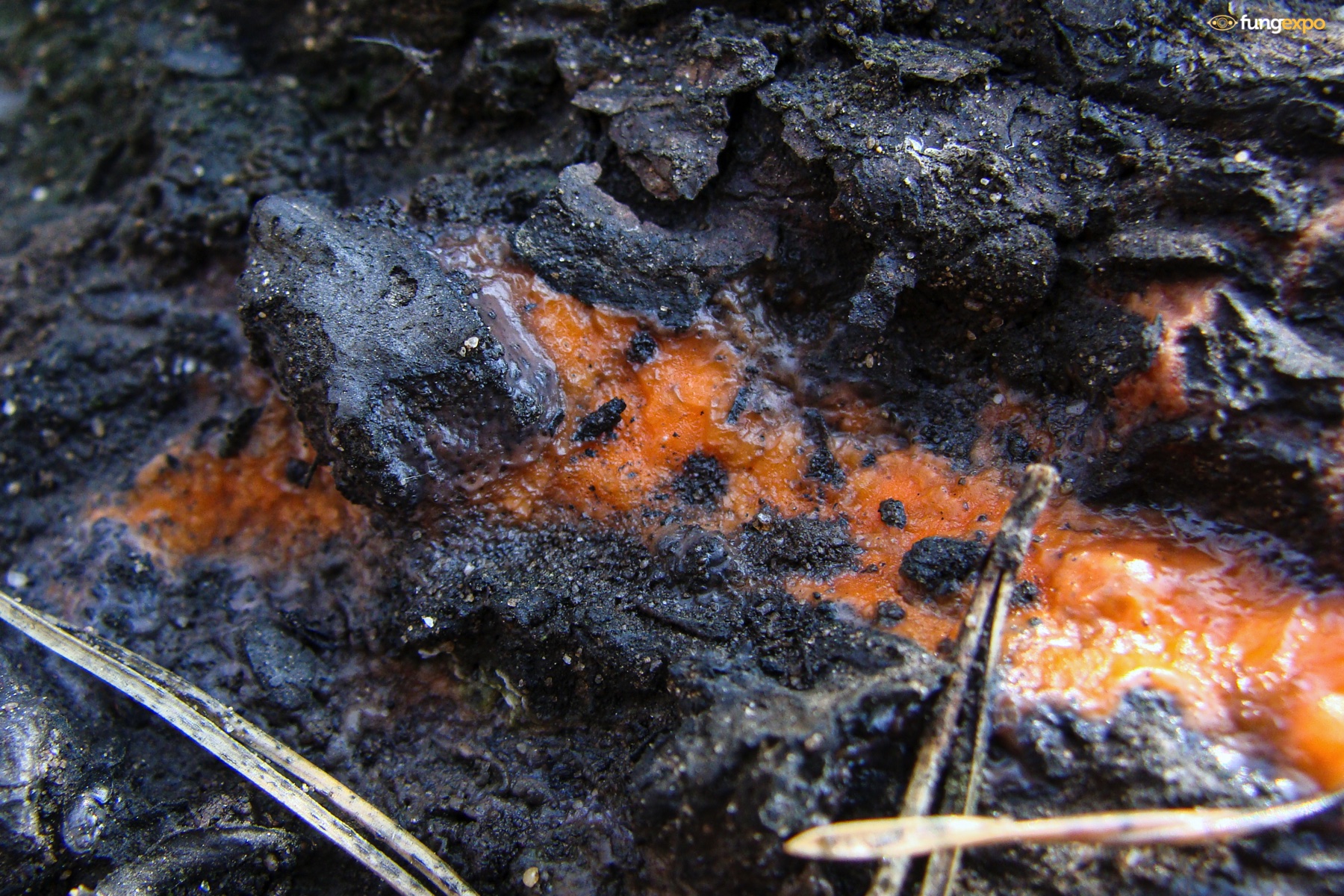
What is its significance? Does it harm the tree?
The main function of the „carrot-yellow tree slime” is to provide structure and protection for the microbes that appear within it, through the biofilm that forms. The colony complex itself also holds evolutionary significance, as the participants become subjects of natural selection, engaging in competition within the system. For the tree, the phenomenon is likely mostly neutral, but indirectly, it can sometimes have harmful or beneficial effects. Deeper microbial penetration could pose a risk of secondary, potentially more dangerous infections. On the other hand, an excessively thick biofilm could slow down wound healing. However, these drawbacks can, depending on the case, also be advantages, as the biofilm (even temporarily) seals the wound, and the participating microbes can successfully compete against other invaders. In any case, there is no clear evidence that the „carrot-yellow tree slime” weakens the affected trees in the long term.
Related sources:
Dan Molter – On the Ontology of Vernal Orange Slime
The most well-known, detailed informative essay on the topic, from both biological and philosophical perspectives.

Cornell Mushroom Blog – Tree slime, stump flux and microbial consortia
A microscope-based, accessible blog post on a specific North American case involving C. macerans.

Weber, R. W. S. (2006) – On the ecology of fungal consortia of spring sap-flows
One of the first scientific papers on the phenomenon, often cited on the topic.

The International Tree Slime Project – Poster: DNA barcoding of fungal volcanoes
A research poster highlighting the diversity of the Fusicolla merismoides species complex.

Park et al. (2017) – Fungal proliferation and calcium accumulation in the orange slime of Cornus controversa
A scientific article that examines the structure of the slime using electron microscopy.